
AI Meets Solar Intelligence: How Drospect Is Redefining Utility-Scale PV Inspections
By Ricardo Honório | EnergyChannel Special Report
As the global solar industry scales at unprecedented speed, a new challenge is emerging across utility-scale operations: managing the enormous volume of inspection data generated by modern photovoltaic assets.
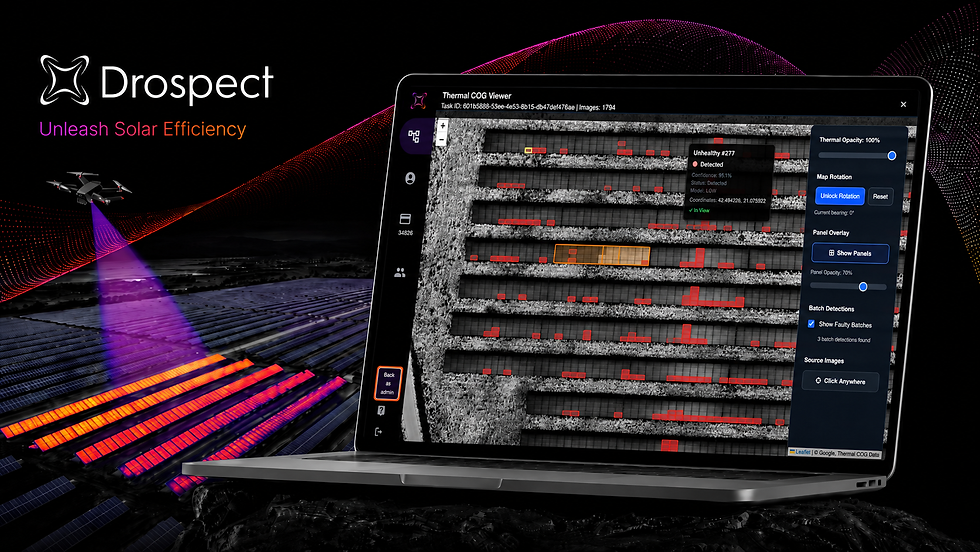
From thermal drone imagery to predictive maintenance analytics, operators are now facing a reality where manual inspection workflows are no longer capable of keeping pace with the growth of solar infrastructure.

It is within this transformation that Drospect Oy positions itself combining artificial intelligence, thermal analytics, and drone-based inspection technologies to modernize how solar assets are monitored and maintained.
According to Meti Latifi, Founder and CEO of Drospect, the industry is rapidly approaching a tipping point where AI is becoming operationally essential rather than optional.
“The solar industry is producing more inspection data than teams can realistically review manually,” explains Latifi. “Our AI automates defect detection, classification, and localization so companies can act faster and make better maintenance decisions.”
The company’s platform analyzes drone-captured thermal and visual imagery to identify hotspots, faulty modules, diode failures, and other performance anomalies. It also generates thermal orthomosaics, automated reporting, and site-level inspection management outputs designed to integrate directly into existing operational workflows.
Flexibility is a core differentiator. Companies can use Drospect as a standalone platform, integrate via API into existing asset management systems, or train custom AI models using their own inspection data.

As solar portfolios expand, the focus is shifting from installation to long-term performance.
AI enables a transition from reactive to condition-based maintenance reducing unnecessary site visits, optimizing technical teams, and improving energy output reliability.
However, challenges remain.
Fragmented data ecosystems where inspection images, SCADA systems, and maintenance logs are disconnected continue to limit operational efficiency. Trust is another critical factor, requiring AI outputs to be accurate, explainable, and reliable.
A recent utility-scale case highlights the impact.
Drospect processed 27,368 thermal images from a ~50 MW solar plant in under 30 hours. A manual review would have required approximately 228 hours of expert analysis.
Beyond cost savings, the system delivered precise defect localization and seamless integration into maintenance workflows.
Looking ahead, the role of AI will be defined not by the volume of data, but by its ability to drive faster, smarter decisions.
Drospect Oy will attend Intersolar Europe 2026 in Munich from June 23–25.
For more information or to schedule a meeting, visit:👉 Drospect Official Website
AI Meets Solar Intelligence: How Drospect Is Redefining Utility-Scale PV Inspections
Comments