
The End of Energy Concentration?
- Energy Channel Global

- 1 day ago
- 6 min read
SPECIAL REPORT

Why every oil crisis strengthens the case for a decentralized energy economy
By EnergyChannel Intelligence
Every oil crisis tells a bigger story
The latest rise in global oil prices was not driven solely by supply and demand.
Renewed security concerns surrounding key maritime routes in the Red Sea, combined with temporary production constraints in Kazakhstan, once again reminded financial markets of a reality that has shaped the global economy for decades: energy security remains one of the world's most influential economic variables.
Whenever geopolitical tensions threaten oil supply chains, markets react almost instantly.
Oil prices rise.
Freight rates increase.
Insurance premiums climb.
Inflation expectations return.
Investors seek safe assets.
Central banks reassess monetary policy.
Although these events may appear temporary, they reveal something much larger than short-term commodity price movements.
They expose the structural characteristics of an economic model that still depends heavily on a relatively small number of producing regions and strategically vulnerable transportation corridors.
While oil continues to play an indispensable role in the global economy, another energy model is gradually emerging one that is more distributed, more resilient and increasingly driven by electrification.
This is not simply a technological transition.
It represents the beginning of a profound transformation in how energy is produced, owned, traded and consumed.
Oil remains the backbone of the global economy
For more than a century, oil has powered economic development.
It fuels transportation networks, aviation, shipping, petrochemical industries, agriculture, manufacturing and national defense.
Modern economies were built around an infrastructure where reliable access to oil became synonymous with economic stability.
Despite rapid advances in renewable energy, global dependence on petroleum remains significant.
Beyond transportation fuels, oil serves as the primary feedstock for thousands of industrial products, including plastics, synthetic fibers, pharmaceuticals, fertilizers, chemicals and countless everyday materials.
For this reason, fluctuations in oil prices affect far more than motorists at gas stations.
They influence virtually every productive sector.
Why regional conflicts become global economic events
Unlike many other commodities, oil production is geographically concentrated.
A relatively limited number of producing countries account for a substantial share of global exports.
At the same time, international oil flows depend on several strategic maritime chokepoints.
When instability affects any of these regions, the consequences extend well beyond the energy sector.
Markets immediately begin pricing geopolitical risk.
Shipping companies revise routes.
Marine insurance costs increase.
Freight becomes more expensive.
Import costs rise.
Manufacturers face higher production expenses.
Consumers eventually absorb part of these increases through inflation.
A localized geopolitical incident can rapidly evolve into a worldwide macroeconomic concern.
This interconnectedness explains why oil continues to occupy a unique position within global financial markets.
The first nine sectors affected by higher oil prices
Historically, sustained increases in oil prices tend to impact economies in a predictable sequence.
1. Transportation fuels
Gasoline.
Diesel.
Jet fuel.
Immediate price adjustments affect consumers and businesses alike.
2. Logistics and transportation
Road freight.
Commercial aviation.
Maritime shipping.
Public transportation.
Transportation costs ripple throughout supply chains.
3. Global trade
Container shipping.
Import and export operations.
Port logistics.
Marine insurance.
International commerce becomes more expensive.
4. Inflation
Higher transportation and production costs eventually reach consumers.
Food.
Consumer goods.
Services.
Construction materials.
Inflationary pressure expands across multiple sectors.
5. Agriculture
Modern agriculture depends heavily on fuel.
Farm equipment.
Harvesting.
Transportation.
Fertilizer production.
Food prices inevitably become more sensitive.
6. Industrial manufacturing
Energy-intensive industries face rising operational costs.
Petrochemicals.
Steel.
Cement.
Automotive manufacturing.
Chemical production.
Profit margins narrow while investment decisions become more cautious.
7. Financial markets
Investors reassess risk.
Equity volatility increases.
Currencies fluctuate.
Government bond markets react.
Capital seeks safer assets.
8. Monetary policy
Persistent energy inflation complicates central bank decisions.
Interest rates may remain higher for longer.
Borrowing costs increase.
Economic growth may slow.
9. Households
Ultimately, consumers absorb much of the economic adjustment.
Higher fuel prices.
More expensive groceries.
Increased utility costs.
Reduced purchasing power.
Lower discretionary spending.
A new energy architecture is emerging
While the traditional energy system continues to demonstrate its vulnerabilities, another model has quietly gained momentum across the world.
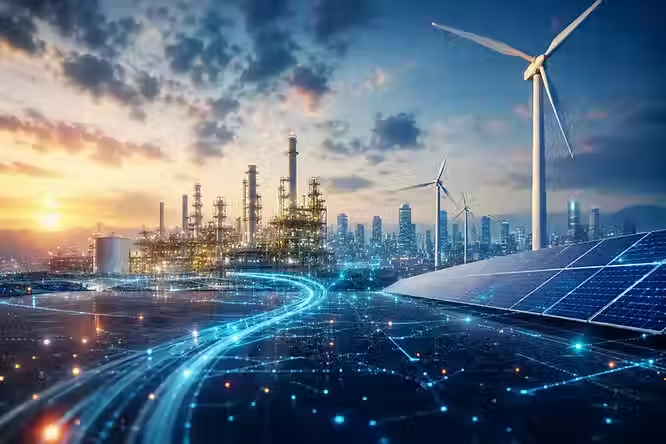
Instead of relying primarily on large centralized production facilities, the new energy economy increasingly consists of millions of distributed assets.
Solar rooftops.
Battery energy storage systems.
Electric vehicle charging infrastructure.
Microgrids.
Community solar projects.
Distributed wind generation.
Behind-the-meter storage.
Digital energy management platforms.
This transformation changes more than the physical infrastructure.
It changes ownership itself.
Millions of consumers are gradually becoming energy producers.
From centralized production to distributed value creation
One of the defining characteristics of the fossil fuel economy has always been concentration.
Oil reserves exist only in certain regions.
Production requires enormous capital investments.
Transportation depends on international logistics.
Market influence remains concentrated among relatively few actors.
Distributed renewable energy follows a different economic logic.
A rooftop solar system can generate electricity almost anywhere.
Battery storage can be installed in homes, factories or commercial buildings.
Electric vehicles become both transportation assets and flexible electricity consumers.
Local businesses participate in installation, software development, engineering, maintenance, financing and digital services.
Economic value becomes more geographically dispersed.
Rather than concentrating wealth around extraction, the energy transition increasingly distributes opportunities across entire societies.
Electrification changes more than transportation
The transition toward electric mobility is often discussed as a change in vehicle technology.
In reality, its implications are considerably broader.
An electric vehicle can be powered by electricity generated from solar, wind, hydroelectric, nuclear or other low-carbon sources.
In many cases, that electricity may even be produced locally.
Every additional electric vehicle connected to an increasingly renewable power system gradually reduces exposure to international oil market volatility.
The significance extends beyond emissions.
It represents diversification.
Greater resilience.
Reduced geopolitical dependence.
More flexible energy systems.
The rise of energy democracy
Perhaps the most significant transformation now underway is not technological.
It is structural.
For decades, energy production remained concentrated among governments, multinational corporations and large utilities.
Today, households, farmers, businesses, industrial facilities and local communities increasingly participate directly in energy generation.
Distributed energy resources are creating what many analysts describe as a more democratic energy ecosystem.
Ownership expands.
Participation increases.
Innovation accelerates.
Competition broadens.
Rather than replacing existing infrastructure overnight, this model gradually complements—and in some sectors eventually transforms—the traditional centralized energy system.
Is this the end of oil?
No.
Oil will remain an essential component of the global economy for decades.
Aviation.
Maritime transport.
Heavy industry.
Petrochemicals.
Chemical manufacturing.
Numerous industrial processes will continue to require petroleum products well into the future.
The question is therefore not whether oil disappears.
The more relevant question is whether oil will continue to exercise the same degree of economic influence it has held throughout the twentieth century.
Current trends suggest that influence may gradually diminish as energy systems become more diversified.
Not because oil loses its importance.
But because societies gain more alternatives.
The economics of resilience
Every major energy transition throughout history has been driven by more than environmental considerations.
Economics has always played a decisive role.
The expansion of renewable generation, battery storage, digital grids and electrification increasingly reflects a search for resilience.
Countries seek greater energy independence.
Companies seek cost predictability.
Consumers seek lower operating expenses.
Investors seek long-term stability.
Distributed energy systems address each of these objectives simultaneously.
Their value therefore extends well beyond carbon reduction.
A transition measured in decades not headlines
Energy transitions rarely occur overnight.
Coal did not disappear when oil emerged.
Natural gas did not eliminate coal.
Renewables will not immediately replace hydrocarbons.
Instead, history demonstrates that energy systems evolve gradually.
Old and new technologies coexist.
Infrastructure adapts.
Markets rebalance.
Investment shifts.
Consumer behavior changes.
The current transition follows that same historical pattern.
Oil remains indispensable.
Yet electricity is becoming increasingly strategic.
Looking beyond the next price spike
Short-term oil price fluctuations will continue to influence markets.
Future geopolitical crises will likely produce similar reactions.
However, each new episode also reinforces a broader strategic lesson.
Economic resilience increasingly depends on diversification.
Countries capable of producing more of their own electricity.
Companies investing in distributed generation.
Industries adopting electrification.
Consumers participating in local energy production.
All become less vulnerable to disruptions occurring thousands of kilometers away.
That may ultimately become one of the defining characteristics of twenty-first century energy systems.
Conclusion
The world is not witnessing the end of oil.
It is witnessing the gradual end of energy concentration as the dominant organizing principle of the global economy.
The transition now underway is not simply replacing one fuel with another.
It is redistributing ownership.
Expanding participation.
Increasing resilience.
And reshaping the relationship between energy, economics and society.
Every geopolitical shock reminds markets of the vulnerabilities embedded in centralized energy systems.
At the same time, every new solar installation, battery system, electric vehicle and microgrid demonstrates that another path is steadily emerging.
The future of energy will not be defined by a single technology.
It will be defined by diversity.
And in that diversity may lie the foundation of a more secure, more resilient and more democratic global energy economy.
This Special Report reflects the editorial analysis of EnergyChannel Intelligence and is intended to contribute to the global discussion on energy security, geopolitics and the long-term evolution of the world's energy systems.
The End of Energy Concentration?


Comments